
Every client I work with eventually asks a version of the same question: “So if I borrow from my own policy, am I just taking my own money out?” No — and that misunderstanding is exactly where most of the confusion about policy loans in the Infinite Banking Strategy comes from. Once you see how this actually works, the rest of the strategy clicks into place. This is really what Policy Loans Infinite Banking comes down to once you strip away the confusion: borrowing against what you’ve built without ever pulling it out of the policy.
What a Policy Loan Actually Is
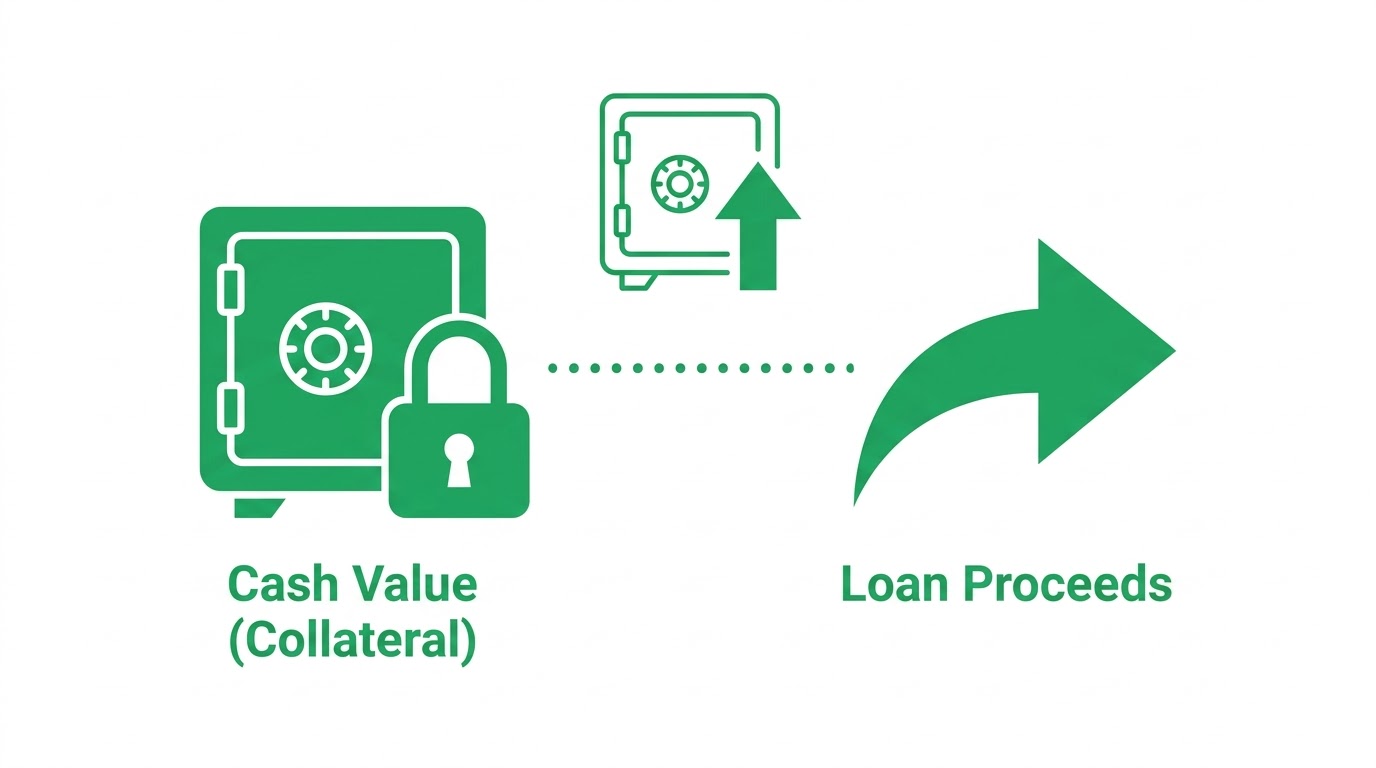
When you take a policy loan, the insurance company isn’t handing you your own cash value. It’s lending you money from its general account and using your cash value as collateral for that loan. Your cash value stays exactly where it is, inside the policy, still growing.
Compare that to a withdrawal, which is a different transaction entirely. A withdrawal actually removes money from your cash value — up to your policy’s cost basis, it’s typically tax-free, but beyond that basis it can trigger taxable income, and a large withdrawal permanently reduces both your cash value and your death benefit. A policy loan does neither of those things while the policy stays in force. That’s the entire mechanism that makes Infinite Banking work.
| Feature | Policy Loan | Withdrawal | Bank Loan |
|---|---|---|---|
| Credit check required | No | No | Yes |
| Underwriting process | None | None | Yes, often weeks |
| Cash value keeps growing | Yes, full balance stays invested | No, the amount withdrawn stops growing | Not applicable |
| Typical tax impact while in force | Generally none | Tax-free up to basis, taxable beyond it | Not applicable |
| Effect on death benefit | Reduced only by any unpaid balance | Permanently reduced by the amount withdrawn | None |
| Repayment schedule | Flexible, set by you | Not applicable, no repayment | Fixed, set by the lender |
Why Your Money Keeps Earning Even While It’s “Loaned Out”
This is the part that sounds too good to be true until you understand the collateral structure. Because the loan is secured by your cash value rather than drawn from it, your full cash value balance continues earning its guaranteed growth — and, with a participating policy, remains eligible for dividends — for the entire time the loan is outstanding.
Picture two dollars doing two jobs at once: one dollar sitting in your policy earning its guaranteed return, and a nearly identical dollar out in the world working for you — funding a business expense, covering an investment, handling an emergency — while you pay it back on a schedule you control instead of one a bank dictates.
How Interest on a Policy Loan Is Calculated and Repaid
Policy loans accrue interest, typically calculated annually, at a rate specified in your policy contract. Some designs use “direct recognition,” where the dividend on the loaned portion is adjusted; others use “non-direct recognition,” where your full cash value earns the same dividend rate regardless of any outstanding loan. This distinction matters enough that it’s worth asking your agent directly which structure your policy uses.
Repayment terms are yours to set. There’s no fixed monthly due date the way there is with a bank loan, no credit check, and no underwriting process to access the funds in the first place. That flexibility is a real advantage — and also the part people misuse most often. An unpaid loan doesn’t disappear. It sits there accruing interest, and if you’re not tracking it against your available cash value, it can grow into a problem you don’t see coming.
What Happens If a Loan Isn’t Repaid
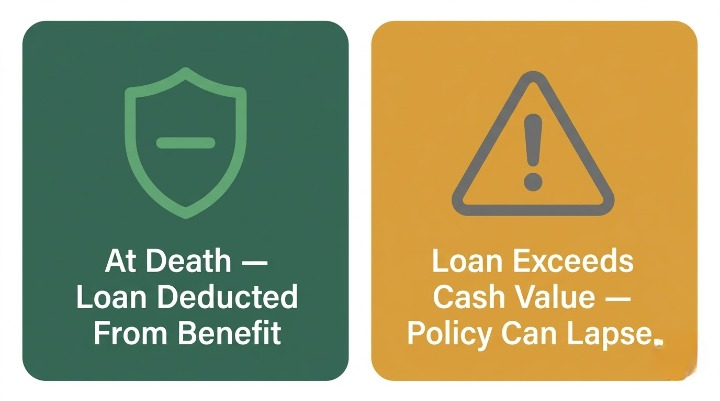
Two things can happen if a policy loan and its accrued interest go unaddressed, and you should know both before you borrow.
If you die with an outstanding loan: The loan balance, plus any accrued interest, is deducted from the death benefit before your beneficiaries receive it. This isn’t automatically catastrophic — it’s simply subtracted, the way an outstanding mortgage balance gets subtracted from home equity.
If the loan balance grows to exceed your cash value: The policy can lapse. This is the scenario to genuinely watch for, because a lapse with an outstanding loan can trigger a tax bill on the gain in the policy — even though you never received that gain as cash in hand. The IRS addresses the general tax treatment of life insurance proceeds and loans in its guidance on life insurance and disability insurance proceeds, which is worth reading if you want the primary source rather than a summary.
The practical takeaway: policy loans are generally not a taxable event as long as the policy stays in force. The danger shows up specifically when a heavily loaned policy lapses or is surrendered — that’s the scenario a properly funded, actively monitored policy is designed to avoid. This is exactly the kind of oversight that shows up on my list of the most common Infinite Banking mistakes I see — a loan balance nobody’s tracking, growing quietly until it isn’t quiet anymore.
Using Policy Loans to Fund Investments, Business Needs, or Big Purchases
This is where the strategy earns its keep. Instead of financing a business expansion, an investment opportunity, or a major purchase through a bank — where the bank collects the interest and the underwriting is entirely out of your hands — you’re financing it through your own policy, on your own terms, and the interest you pay works toward your own financial system instead of someone else’s balance sheet.
I want to be direct about something here: this doesn’t mean the money is free, and it doesn’t mean the discipline disappears. You’re still borrowing. You still owe it back. The advantage is who you’re borrowing from and where the interest ends up — not that repayment stops mattering.
How This Connects to Velocity Banking
If you’ve worked through Velocity Banking to clear your mortgage or high-interest debt, a funded Infinite Banking policy becomes a natural next tool. Instead of relying exclusively on a HELOC or personal line of credit to fund a “chunk” against debt or an investment opportunity, a properly funded policy gives you a second source of capital — one where the interest you pay flows back into your own system rather than a bank’s. The two strategies were never meant to compete with each other; they’re built to run in sequence.
Illustrative figures and general tax treatment described above reflect information published on denzelrodriguez.com and general IRS guidance current as of publication — this is educational content, not tax or legal advice. Confirm your specific policy’s loan terms with your carrier and consult a tax professional for your situation.
Frequently Asked Questions
Is a policy loan the same as withdrawing my cash value?
No. A withdrawal removes money from your cash value and can reduce your death benefit permanently. A loan borrows against your cash value as collateral while leaving it fully in place and still earning.
Do I have to pay taxes on a policy loan?
Generally, no, as long as the policy remains in force. Taxes typically only become a concern if the policy lapses or is surrendered while a loan is outstanding and exceeds your basis.
Is there a credit check to take a policy loan?
No. Because the loan is collateralized by your own cash value, there’s no credit check and no traditional underwriting.
How fast can I access a policy loan?
This varies by carrier, but funds are often available within days. Some policy contracts technically allow the insurer up to six months to process a loan, though invoking that provision is rare in practice.
Curious How a Policy Loan Could Fit Into Your Plan?
Reading about the mechanics is useful. Seeing how it applies to your actual policy, your actual cash value, and your actual next big expense is a different conversation. Whatever stage you’re at, understanding what Policy Loans Infinite Banking actually relies on is the first step before you borrow a dollar against your own policy. Let’s map it out together — or start with the fuller picture in the Infinite Banking Strategy overview.
Book a Strategy Call