
I’ve reviewed a lot of policies that people were sold as “Infinite Banking” that weren’t actually built to do the job. Not because the strategy doesn’t work — it does, when it’s structured right — but because someone skipped a step, or an agent optimized for the wrong thing, or the policyholder treated it like something it isn’t. Here are the five Infinite Banking mistakes I see most often, roughly in order of how much they cost people.
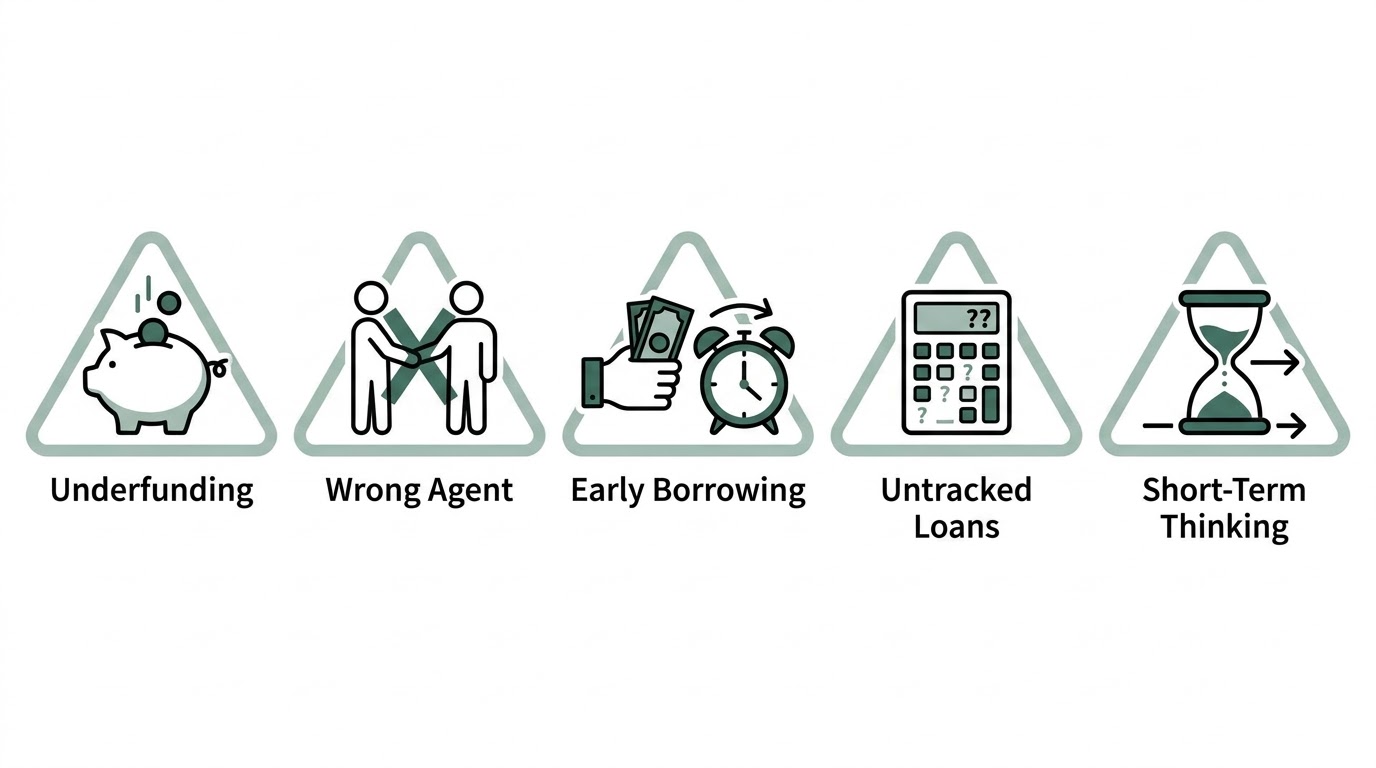
Mistake #1: Underfunding the Policy in Year One
This is the most common mistake, and it’s usually not the policyholder’s fault — it’s how the policy was designed from the start. If a policy is set up with a high base premium and a thin Paid-Up Additions rider, cash value builds slowly no matter how disciplined you are about paying on time. A policy engineered correctly, with the base premium minimized and the PUA rider maximized, can reach somewhere between 80% and 90% of cash value in year one. A policy engineered the wrong way might show close to nothing.
The fix: before you sign, ask specifically what percentage of your premium goes to the PUA rider versus the base policy. If your agent can’t answer that clearly, that’s a sign to get a second opinion before you fund anything.
Mistake #2: Choosing the Wrong Agent or Carrier for IBC-Specific Design
Most life insurance agents are trained to sell death benefit. Infinite Banking requires the opposite instinct — minimizing insurance cost, maximizing cash value. These are genuinely different skill sets, and a generalist agent selling you a “whole life policy” isn’t the same as an agent who specifically designs policies for this strategy.
This mistake compounds because it’s invisible for years. You won’t necessarily know your policy is underperforming until you compare it against a properly designed one, by which point you’ve lost several years of growth you can’t get back.
The fix: work with someone who specializes in IBC-specific design, and ask for the guaranteed cash value numbers in years 1, 5, and 10 — not just the illustrated, non-guaranteed projection.
Mistake #3: Borrowing Against the Policy Too Early
I understand the temptation. You fund a policy, you see cash value start to build, and it feels like access to money you didn’t have before. But borrowing before there’s enough cash value to make the loan worthwhile just slows down the compounding that makes this strategy work in the first place. Every dollar you pull out early is a dollar that isn’t sitting in the policy earning its guaranteed growth and any dividend that comes with it.
The fix: give the policy real time to build before you start using it as a lending source — most practitioners think in terms of several years of consistent funding before loans become genuinely practical, not months. For the full mechanics of how a policy loan actually works, and why timing matters this much, see Policy Loans Infinite Banking: How Borrowing Against Your Own Cash Value Actually Works.
Mistake #4: Not Tracking Loan Balances Against Available Cash Value
This is the mistake that turns a good strategy into a real problem. A policy loan accrues interest whether you’re paying attention to it or not, and if the balance grows large enough relative to your cash value, the policy can lapse. A lapse with an outstanding loan can create a taxable event on gain inside the policy — even though you never touched that money as cash.
The fix: review your loan balance against your cash value at least annually, and treat repayment as a real obligation, not an optional extra just because there’s no bank enforcing a due date.
Mistake #5: Treating It Like a Quick-Return Investment
Infinite Banking is a cash-flow and liquidity strategy built on guaranteed, predictable growth — not a stock-market alternative chasing fast returns. People who fund a policy expecting it to outperform in year two are almost always disappointed, and that disappointment sometimes leads to surrendering a policy right around the point it was about to start working, since break-even typically lands somewhere between years three and six for a properly designed policy.
The fix: go in with realistic expectations from day one. This is a multi-year system, and the compounding advantage shows up over a decade or more.
How to Course-Correct If You’ve Already Made One of These
None of these mistakes are necessarily fatal, and I’d rather you know that than assume the policy is a lost cause. A few starting points:
- If your policy is underfunded, it may be possible to restructure future funding toward the PUA rider — this depends on your specific policy and carrier, so it’s worth a review rather than a guess.
- If you’re not sure your agent designed the policy correctly, get a second opinion. A qualified reviewer can look at your illustration and tell you within a few minutes whether the design matches IBC principles or standard death-benefit coverage.
- If you’ve been borrowing early and often, slow down and let the cash value rebuild before drawing more.
- If you’ve lost track of a loan balance, request a current in-force illustration from your carrier and see exactly where you stand against your cash value.
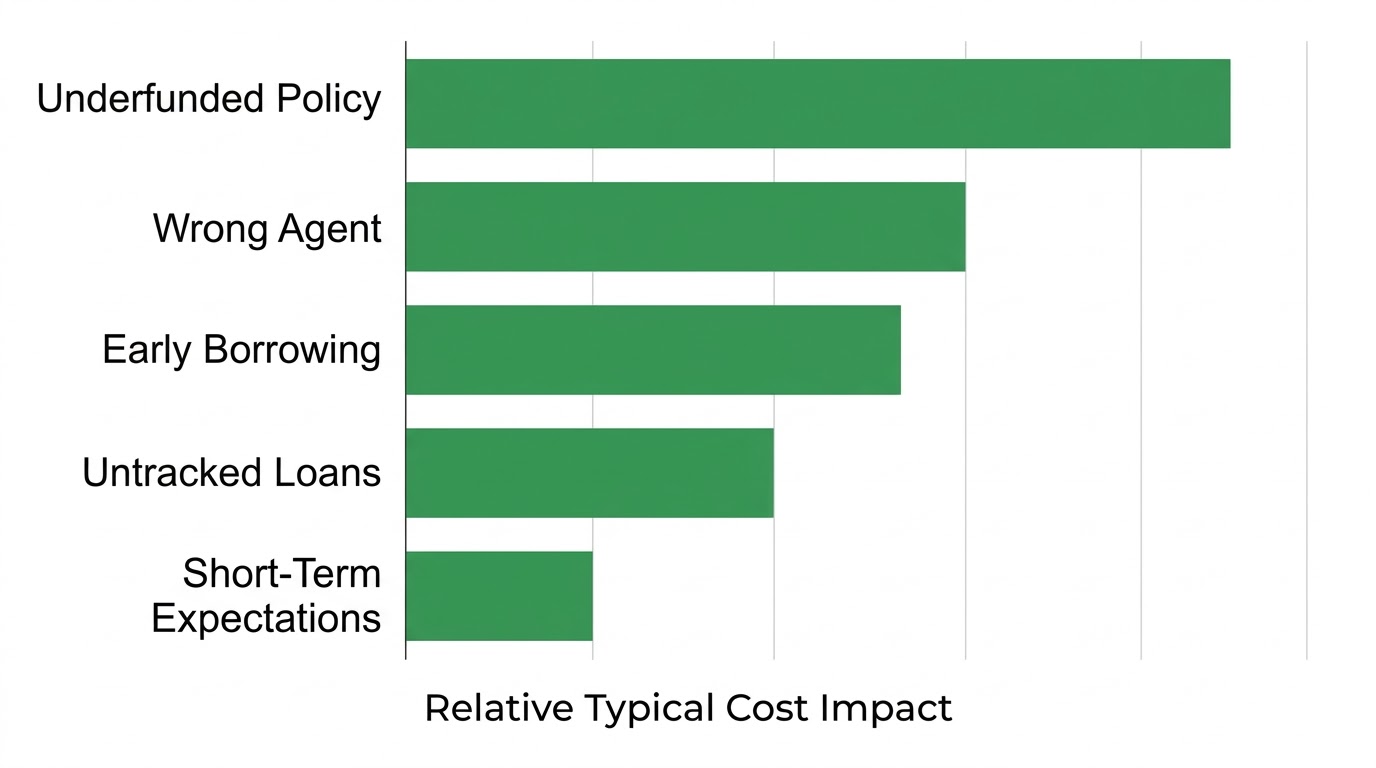
Where These Mistakes Come From, in Comparison
| Mistake | Root Cause | Typical Cost |
|---|---|---|
| Underfunded policy | Wrong premium-to-PUA ratio at setup | Years of lost cash value growth |
| Wrong agent | Generalist selling death benefit, not IBC design | Underperforming policy that looks fine on paper |
| Early borrowing | Misunderstanding how compounding builds | Slower growth of usable capital |
| Untracked loan balance | No annual review habit | Risk of lapse and taxable gain |
| Short-term expectations | Treating IBC like an investment, not a system | Early surrender at the worst possible time |
Illustrative figures throughout reflect information published on denzelrodriguez.com and general IBC practitioner guidance. This is educational content, not individualized financial or tax advice — consult a qualified professional about your specific policy.
Frequently Asked Questions
Is it too late to fix an underfunded policy?
Usually not entirely — it depends on how the policy was structured and how much time is left to restructure funding. It’s worth a review rather than assuming the worst.
How do I know if my agent designed my policy correctly?
Ask for your guaranteed cash value figures in years 1, 5, and 10, and ask what percentage of premium is going to the PUA rider. If those numbers look thin, get a second opinion.
Does it help to just add more money to a poorly designed policy?
Sometimes, but not always — a poorly structured base policy can limit how much of that new money actually reaches cash value efficiently. This is a case-by-case answer, not a blanket one.
What’s the single biggest mistake on this list?
Underfunding in year one, because it’s baked in at setup and its effects compound silently for years before anyone notices.
Think Your Policy Might Be Underfunded or Mis-Designed?
If anything above sounded familiar, it’s worth getting a second set of eyes on your policy before more time passes. Most Infinite Banking mistakes are fixable if you catch them early — the sooner we look, the more options you have. Start with the full Infinite Banking Strategy overview if you’re building one from scratch, or book a call and we’ll take a look at what you already have.
Book a Strategy Call