
Two strategies, two different jobs, one household plan: here’s how I actually sequence them.
If you’ve read through the Velocity Banking Strategy pillar and the Infinite Banking Strategy pillar back to back, you’ve probably landed on the same question I get in almost every consultation: do I do one, or both, and in what order?
Velocity Banking and Infinite Banking aren’t competing systems fighting for the same dollar. They solve two different problems, and in my own household, I run them at the same time, just not always at full throttle on both.
This piece is the one that ties the two clusters together: why these strategies aren’t interchangeable, a general sequencing framework for combining them, how a policy loan can eventually fund a Velocity Banking chunk, what the combined approach looks like applied to real estate, and where people tend to get hurt when they try to move too fast on both fronts at once.
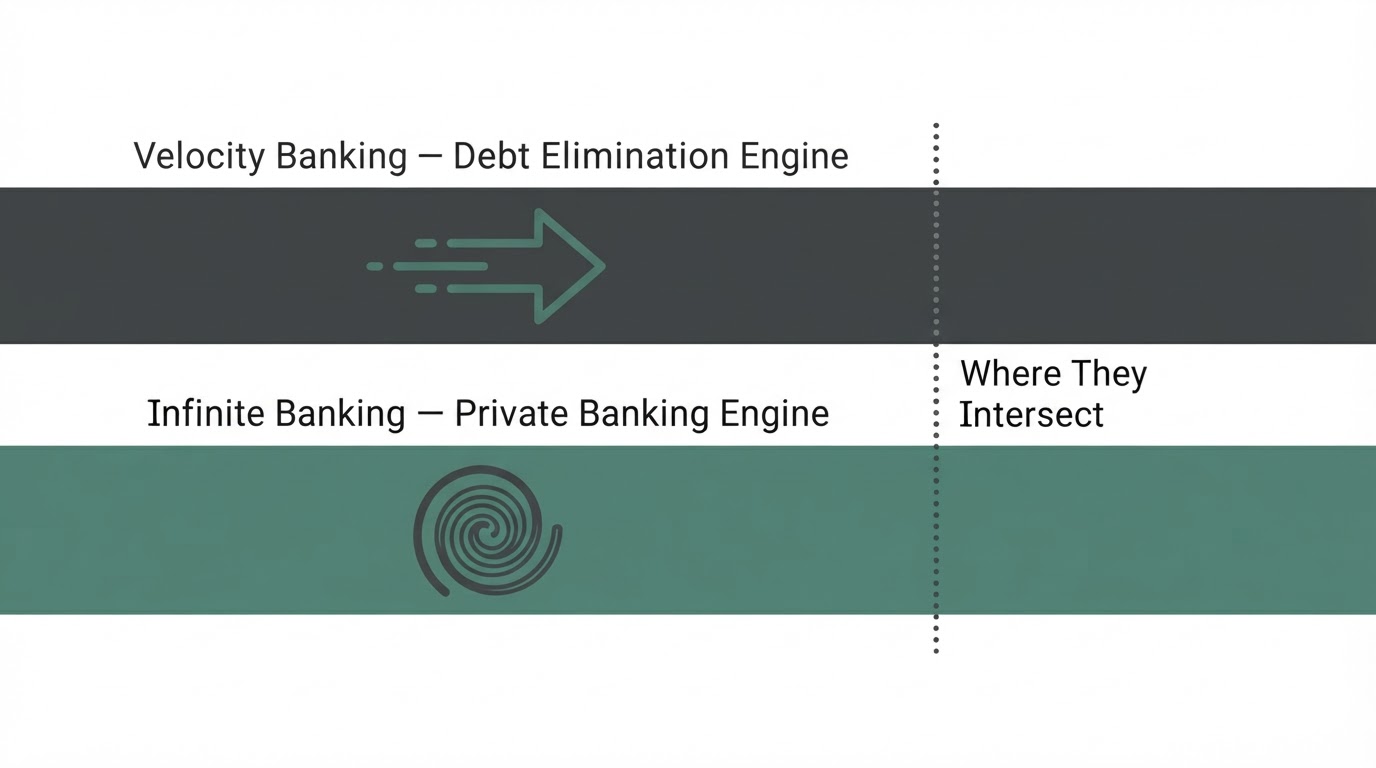
Why These Two Strategies Solve Different Problems
Velocity Banking is built for speed. It uses a HELOC or similar line of credit to compress interest on a mortgage or other amortized debt by running income through the line instead of a checking account, chunking down principal faster than the standard payment schedule allows. It’s a debt-elimination tool, full stop. It doesn’t build a pool of capital you own outright, it accelerates you out of a specific liability.
Infinite Banking is built for time. A properly designed whole life policy grows cash value slowly at first and then compounds, becoming a source of capital you can borrow against for decades, not months. It’s not trying to eliminate anything quickly. It’s trying to give you a private reservoir of money that works for you whether or not you ever borrow against it.
Put them side by side and the difference is really about time horizon and function: one clears debt fast, the other builds a lasting asset slowly. Treating them as competitors, “which one should I do”, misses that most households have room, and reason, to run both.
| Question | Velocity Banking | Infinite Banking |
|---|---|---|
| Problem it solves | Eliminating an existing debt faster and with less total interest | Building a long-term, self-controlled pool of capital |
| Typical timeframe to see results | Months to a few years, depending on the debt | 5–15+ years for meaningful compounding |
| Primary tool | HELOC or similar revolving line of credit | Whole life insurance cash value and policy loans |
| Best fit | Households with steady income and an existing amortized debt | Households wanting a permanent, portable banking system |
A General Sequencing Framework: What Usually Comes First
There’s no universal order that fits every household, but a general pattern shows up often enough that it’s worth laying out. In most cases, Velocity Banking comes first. It’s usually easier for someone to qualify for a HELOC or similar line of credit than it is to fund a whole life policy at a meaningful level right away, so starting there lets a household begin accelerating debt payoff immediately. Paying down debt faster frees up cashflow, and that freed-up cashflow is often what eventually funds the policy.
A whole life policy needs real capital behind it to grow efficiently, often $10,000 or more a year, for cash value to build into something meaningful within the first five to seven years. Starting Infinite Banking too early puts a strain on Velocity Banking and slows results on both fronts at once, which is usually the trap for most Americans working with a single income stream. Households with higher income and stronger cashflow are the exception, they can often afford to start a whole life policy earlier because they can wait for the results to show up.
Where they start to intersect is once Velocity Banking has freed up enough margin, or a policy funded from the start has built enough cash value, to actually fund something meaningful. That’s the point where a household running both tools can start deciding whether the next chunk of debt payoff comes from the HELOC, the policy, or some combination of both. That intersection point is really the beginning of the “combined” part of this framework, everything before it is really just one strategy carrying more of the weight while the other gets established.
Funding a Velocity Banking Chunk With a Policy Loan
Once a policy has built enough cash value, some people use a policy loan instead of a HELOC draw to fund a Velocity Banking chunk, or they use both together, splitting a large chunk across the two sources. The appeal is that the interest paid on a policy loan effectively stays inside your own financial ecosystem rather than going to an outside lender, since the policy’s cash value continues earning while the loan is outstanding.
This only works once there’s real cash value to borrow against, which is why sequencing matters. A policy in its first or second year typically won’t have enough built up to fund a meaningful chunk. This is a brief overview of a much deeper mechanical topic, the exact math on rates, loan provisions, and how to structure the chunk itself is covered in full in Funding a Velocity Banking Chunk With a Policy Loan, which walks through a worked example step by step.
Applying the Combined Framework to Real Estate
This is where the combined approach tends to click for people. Velocity Banking can be used to pay down a rental property’s mortgage faster than its amortization schedule, building equity ahead of schedule. Meanwhile, a growing whole life policy can become the source of a down payment on the next property, accessed through a policy loan rather than a traditional mortgage pre-approval process or a cash-out refinance.
Run long enough, this creates something closer to a private banking system for real estate investing, you’re not just paying off one property faster, you’re funding the next acquisition from a pool of capital you control, on your own timeline, without waiting on a lender’s underwriting. It’s not without real tradeoffs and risks, particularly around leverage and policy loan balances stacking up across multiple properties, which is exactly why this deserves its own deep dive rather than a paragraph here. That full breakdown, including how to think about leverage across multiple properties, lives in Velocity Banking and Infinite Banking for Real Estate Investing.
What a Multi-Year Combined Plan Can Look Like
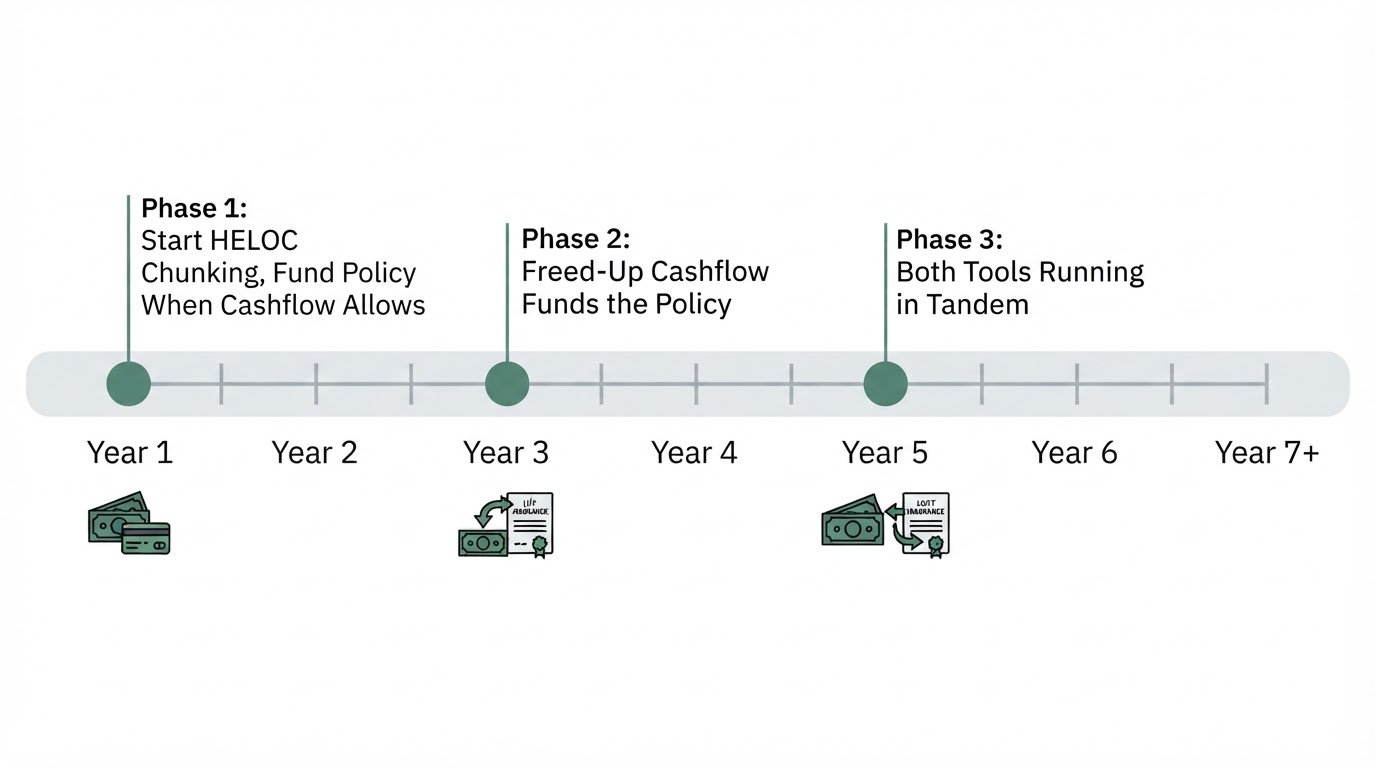
Zoomed out, a combined plan tends to move through a few general phases: an early phase where a HELOC chunking system is set up against a primary debt, with the policy either held at a modest funding level or started once cashflow allows; a middle phase, often a few years in, where debt payoff has freed up enough margin to fund the policy at a meaningful level and cash value starts building in earnest; and a later phase where the household is running both tools in tandem, using policy loans for major moves like real estate or business capital while continuing to fund the policy and manage HELOC balances responsibly.
The exact timeline depends heavily on income, how aggressively the policy is funded early on, and how much existing debt is being targeted with Velocity Banking. A household with a smaller mortgage and strong cash flow margin will move through these phases faster than one carrying significant consumer debt alongside a large mortgage. For a full year-by-year illustration of how this can play out, including specific dollar ranges and decision points, see A Multi-Year Combined Plan: Velocity Banking and Infinite Banking Together.
How to Know Which Strategy to Prioritize Based on Your Own Numbers
If you’re trying to decide where to put your next dollar of margin, the honest answer depends on your specific numbers, not a general rule. High-interest, non-mortgage debt usually deserves attention first, regardless of which framework you’re using, the math on a 22% credit card balance rarely loses to anything else competing for that dollar.
Beyond that, if your primary goal is compressing a mortgage or similar amortized debt, front-loading Velocity Banking while starting a policy at a modest, sustainable funding level tends to work better than starving the policy to chunk debt faster.
If your priority is long-term flexibility and you already have manageable debt, it can make sense to fund the policy more aggressively from the start and let Velocity Banking run at a steadier pace.
There’s a broader body of thinking on sequencing debt payoff against wealth-building more generally, Investopedia has an overview of integrated debt-and-wealth-building strategies worth reading for additional context beyond this framework specifically.
(Note: confirm and swap in the exact Investopedia article URL before publishing, this is a placeholder link.)
None of this replaces sitting down with your actual income, debt balances, and interest rates, which is a conversation worth having before committing to a specific sequence.
Common Pitfalls When Combining Strategies Too Aggressively
- Overleveraging the HELOC. Chunking too large a portion of income through a line of credit can leave a household without enough liquidity for an emergency, defeating the purpose of accelerating debt payoff in the first place.
- Underfunding the policy to move faster on debt. Cutting policy premiums to redirect more toward Velocity Banking can stunt cash value growth in the exact years it needs momentum, delaying the point where the policy becomes useful.
- Borrowing against cash value before there’s enough of it. Taking a policy loan too early can leave a policy thin on cash value and vulnerable to lapse if premiums are missed.
- Losing track of combined loan balances. Running a HELOC balance and a policy loan balance at the same time requires actually tracking both, treating them as separate, unrelated numbers is how people overextend without realizing it.
- Treating projections as guarantees. Every number in a Velocity Banking or Infinite Banking illustration is a projection built on assumptions, actual results shift with real interest rates, real dividends, and real spending discipline.
This article is general financial education, not personalized financial, legal, or tax advice. All rates, dividend figures, cash value growth assumptions, and dollar amounts referenced or implied above are illustrative examples only, not quotes, projections, or promises tied to any specific policy or lender. Loan terms, HELOC rates, and policy loan provisions vary by lender and carrier and change over time. Confirm current rate ranges and policy figures against up-to-date sources before publishing or presenting this material, and consult a qualified professional about your specific situation before acting on anything discussed here.
Frequently Asked Questions
Do I need to master Velocity Banking before I start Infinite Banking?
Not exactly, but for most households Velocity Banking tends to lead. It’s usually easier to qualify for a HELOC than to fund a policy at a meaningful level right away, and the cashflow Velocity Banking frees up is often what ends up funding the policy. Households with strong income and cashflow are more often the exception, they can afford to start both closer to the same time.
Can a policy loan really replace a HELOC for a Velocity Banking chunk?
Once a policy has enough cash value, yes: some people use policy loans instead of, or alongside, a HELOC. The tradeoff is timing: a brand-new policy won’t have the cash value to do this in year one.
Is combining these two strategies riskier than doing just one?
It can be, if it’s rushed. Overleveraging a HELOC while underfunding a policy in its early years is the most common way people get themselves into a tighter spot instead of a freer one.
How long before I see real results from the combined framework?
Velocity Banking results can show up in months on a single debt. Infinite Banking’s real value compounds over years. A combined plan is usually built to be evaluated on a multi-year horizon, not a monthly one.
Curious Where Velocity Banking and Infinite Banking Could Take Your Plan?
Reading about the framework is one thing. Seeing how Velocity Banking and Infinite Banking sequence against your actual debt, your actual policy numbers, and your actual timeline is another conversation entirely. Let’s map it out together.
Book a Strategy Call