
Once you’ve read the full Velocity Banking and Infinite Banking framework, one question tends to come up more than any other: can a policy loan actually replace the HELOC I’m already using to chunk down my mortgage? The short answer is yes, under the right conditions — and this is the piece that walks through exactly how people fund Velocity Banking with Infinite Banking in practice, what it costs compared to a traditional line of credit, and where the real risks sit if you lean on it too hard, too soon.
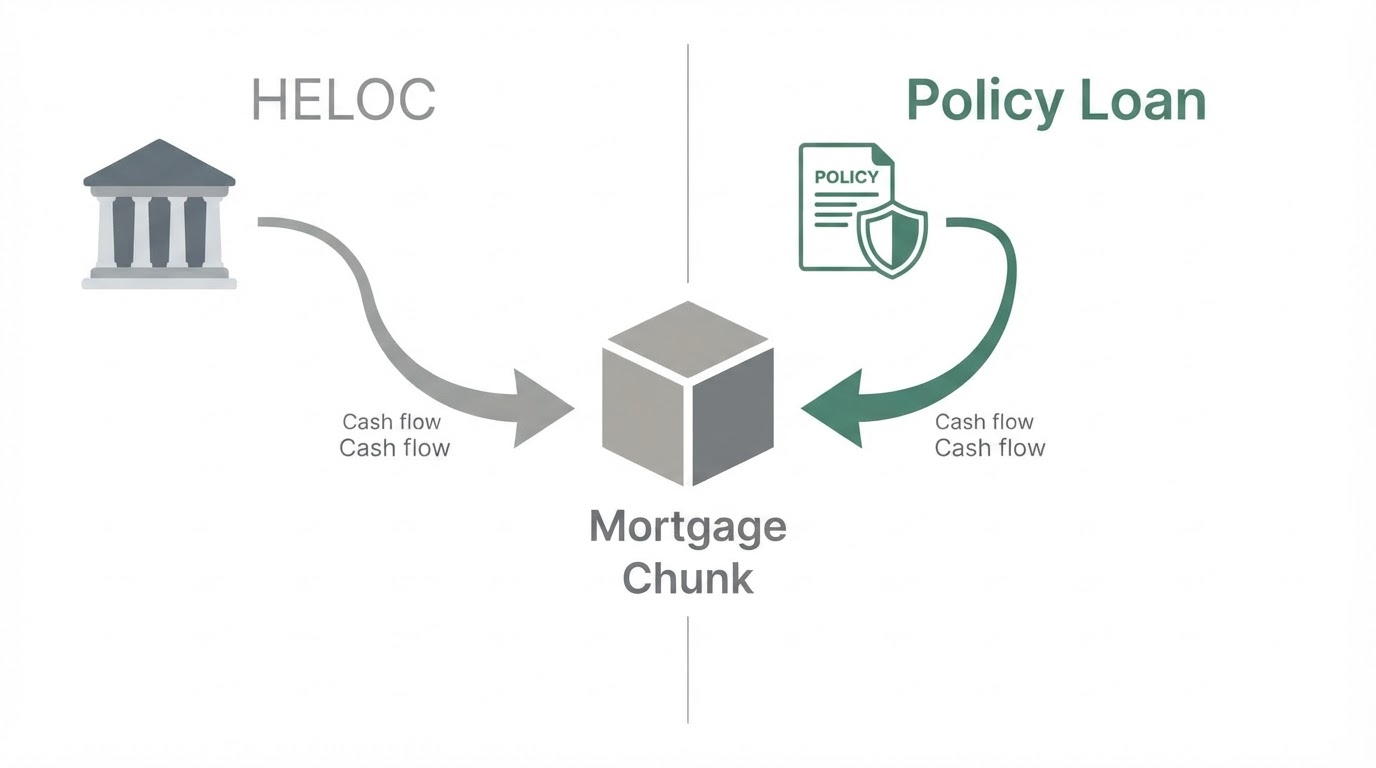
Why Some People Use a Policy Loan Instead of a HELOC to Fund a Chunk
A HELOC works fine for chunking, and plenty of people run their entire Velocity Banking strategy on one without ever touching a policy loan. But once a whole life policy has built up real cash value, it becomes a second, parallel source of capital for the exact same job — funding a lump-sum “chunk” against a mortgage or other amortized debt.
The appeal comes down to where the interest goes. With a HELOC, the interest you pay leaves your household and goes to the bank. With a policy loan, the cash value backing the loan keeps earning its guaranteed growth the entire time the loan is outstanding, so the arrangement stays closer to home. Some people use one or the other depending on the season; others split a single chunk across both, using the HELOC for part of it and a policy loan for the rest.
There’s also a qualification angle worth mentioning. A HELOC depends on your credit profile, your income documentation, and the lender’s current appetite for extending credit — all of which can shift for reasons that have nothing to do with your actual ability to repay. A policy loan doesn’t carry that exposure. As long as the cash value is there, the loan is available, which is part of why some people treat a funded policy as a backup source even if they primarily chunk through a HELOC.
Comparing Cost and Flexibility: Policy Loan vs. HELOC for Chunking
| Feature | Policy Loan | HELOC |
|---|---|---|
| Credit check / underwriting | None | Required, including income and credit review |
| Rate structure | Fixed or variable, set by policy contract | Variable, tied to the prime rate |
| Where interest ends up | Stays connected to your own cash value growth | Paid entirely to the lending bank |
| Available from day one? | No — requires built-up cash value first | Yes, once approved and the line is open |
| Effect on outside borrowing capacity | None — doesn’t appear on a credit report | Can affect debt-to-income ratio for other loans |
| Repayment schedule | Flexible, set by you | Minimum payments required, draw period limits apply |
Rates on both sides move with the broader market, so the gap between them narrows and widens over time — check current terms before assuming either option is automatically cheaper. As one general reference point, Bankrate’s national HELOC rate survey is a reasonable place to check where average line-of-credit rates stand before comparing them against your policy’s loan provision.
A Simplified Worked Example
The following numbers are illustrative only, not a quote, projection, or promise tied to any specific lender or policy. Say you’ve identified a $12,000 chunk to run against your mortgage principal this quarter. Funding it entirely through a HELOC at an illustrative variable rate leaves you paying that rate to a bank until it’s repaid, with a minimum payment due on the standard schedule. Funding the same $12,000 chunk through a policy loan against a policy with, say, $30,000 in available cash value leaves your full $30,000 still earning its guaranteed growth throughout the loan, and you set the repayment pace yourself rather than following a lender’s minimum-payment schedule.
Neither option is free money — you’re still repaying what you borrowed either way. The difference this example is meant to illustrate is structural: who holds the loan, how the repayment terms work, and where the ongoing growth happens while the balance is outstanding. Run the same comparison against your own chunk size and your own policy’s illustrated loan rate before deciding — the mechanics matter more than which option sounds better in theory.
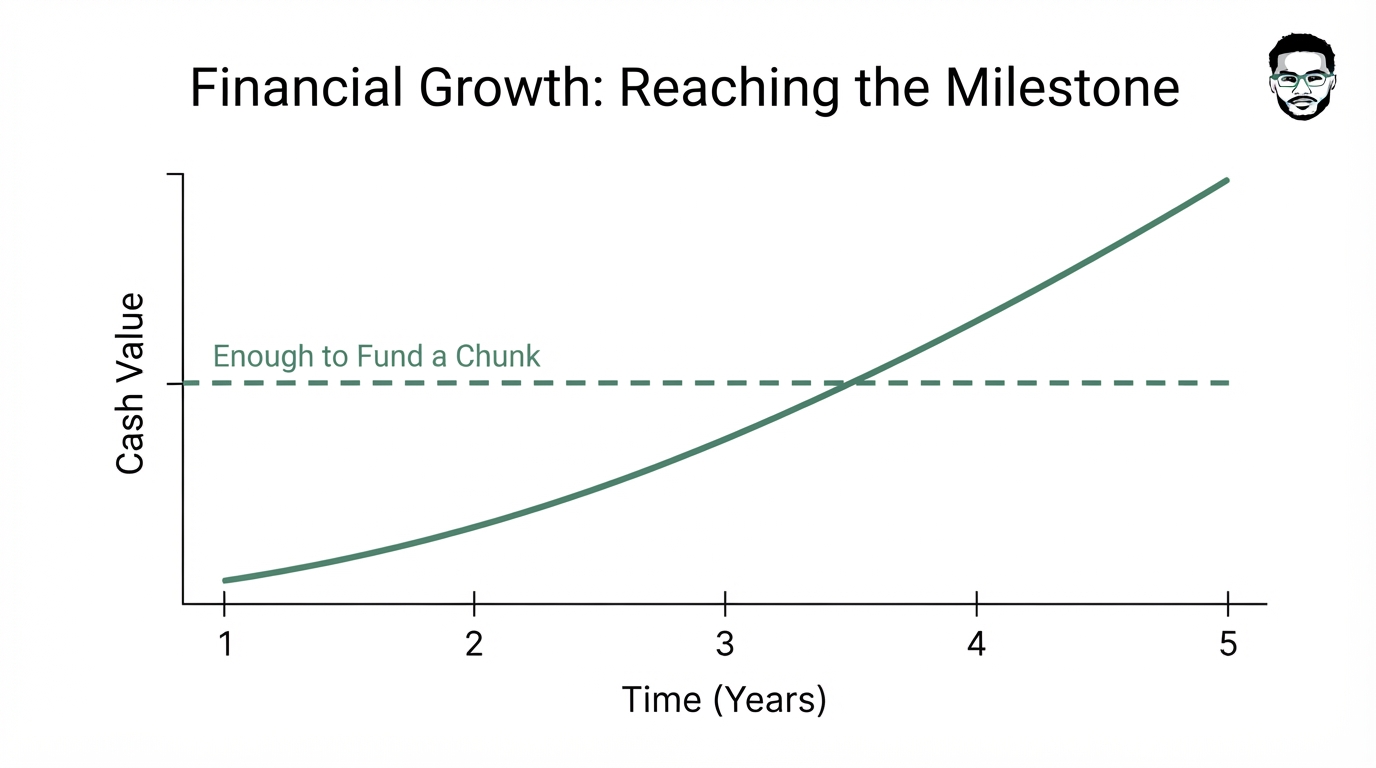
Cash-Value Timeline Considerations: Why This Usually Isn’t a Year-One Move
A brand-new policy simply won’t have the cash value to fund a meaningful chunk in its first year or two, regardless of how it’s designed. This is why most people run Velocity Banking entirely on a HELOC in the early years of a policy, then start introducing policy loans once there’s a real balance to work with. For the full mechanics of how a policy loan is structured, calculated, and repaid, see how policy loans actually work — it’s worth understanding that mechanism fully before using it for anything as active as chunking.
Trying to force this move too early usually backfires. Borrowing against thin cash value can leave a policy vulnerable and slow down the very compounding that would have made it a useful funding source a few years later.
Risks of Leaning on Policy Loans Too Heavily
Using a policy loan for one chunk is very different from routing every chunk through the policy going forward. Stack too many outstanding loans against the same policy and you risk a balance that grows faster than your cash value can support, which can put the policy at risk of lapsing. A lapse with a large loan balance outstanding can also trigger a taxable event on the gain inside the policy — a scenario covered directly in the IRS’s guidance on life insurance and disability insurance proceeds, worth reading if you want the primary source.
The practical guardrail: know your outstanding loan balance relative to your cash value before taking on another one, and treat the HELOC as your primary chunking tool until the policy has enough size and history to comfortably take on real weight. There’s no fixed rule for exactly how much loan-to-cash-value is safe — it depends on your policy’s design, how consistently it’s funded, and how much cushion you want against a swing in your other financial obligations. That’s a conversation worth having with whoever designed your policy, not a number to guess at from a blog post.
All rate ranges, dollar figures, and policy examples above are illustrative only, not quotes, projections, or promises tied to any specific lender or carrier. HELOC and policy loan terms vary and change over time. Confirm current rates and your specific policy’s loan provisions before acting, and consult a qualified professional about your situation.
Frequently Asked Questions
Can I use a policy loan for my very first Velocity Banking chunk?
Only if your policy already has enough cash value, which usually isn’t the case with a brand-new policy. Most people start with a HELOC and introduce policy loans later.
Is a policy loan always cheaper than a HELOC?
Not necessarily. Rates on both move with the market, and the better option depends on your specific policy terms and the HELOC rate you’d otherwise qualify for.
Can I use both a HELOC and a policy loan for the same chunk?
Yes. Splitting a chunk across both sources is common once a policy has enough cash value to make a meaningful contribution.
What happens if I over-borrow against my policy?
A loan balance that grows too large relative to your cash value puts the policy at risk of lapsing, which can trigger a taxable event on any gain inside it. Keeping the balance well below your available cash value is the safeguard.
Want to See If This Combo Fits Your Numbers?
Deciding whether to fund your next chunk with a HELOC, a policy loan, or a mix of both depends entirely on your actual cash value, your actual rate, and your actual debt balance. Book a call with our team.
Book a Strategy Call