
To become your own banker means you control the financing in your life instead of handing that job to a bank. You build a pool of money, usually inside a properly designed whole life policy, and you borrow from it and pay it back yourself. The interest and the decisions stay with you. I teach this through my Infinite Banking work.
The phrase gets used a lot, and it can sound like a slogan. It’s a real shift in how you think about money, though, and it starts with one simple observation.
You finance everything you buy
Nelson Nash, who created the Infinite Banking Concept, made this point in his book Becoming Your Own Banker. Every purchase is financed one way or another.
If you take a car loan, you pay interest to the lender. That one is obvious. But if you pay cash, you’re still paying a cost. You give up the interest or growth that money would have earned if you had left it alone. Either way, money leaves your hands.
Once you see that, the question changes. It stops being “Should I finance this?” and becomes “Who am I going to finance this through?”
What being your own banker looks like in practice
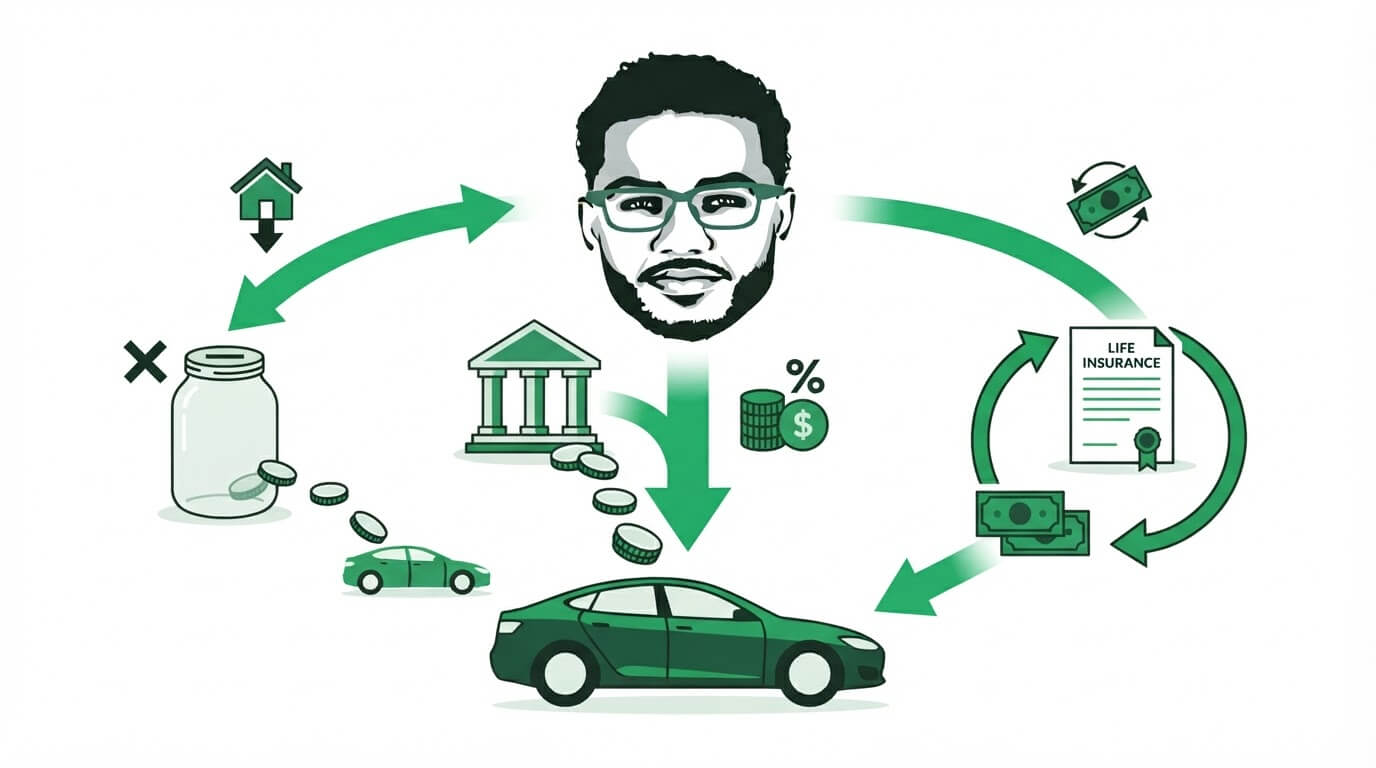
Say you need a $20,000 vehicle. Here are your three options.
- Pay cash from savings. Your savings drop to near zero, and that money stops earning anything.
- Take a bank loan. You need approval, you pay the bank’s rate, and you follow the bank’s schedule.
- Take a policy loan. You borrow against your cash value, which keeps growing in the policy. You set up your own repayment plan, and as you pay it back, your borrowing room is restored for the next purchase.
With the third option, you’re acting like the bank. You decide the terms. And the payments you would have made to a lender go back into a system you own.
Now picture doing that over twenty or thirty years. Cars, home repairs, a child’s tuition, a down payment on a rental. Each of those purchases would normally send interest to a lender. When they run through your own policy instead, that money keeps circling back to your family. That’s the long game Nelson Nash was describing.
| Factor | Paying Cash | Bank Financing | Policy Loan (Your Own Bank) |
|---|---|---|---|
| Approval needed | No | Yes | No |
| What happens to your savings | Drops by the full amount | Stays, but you owe the bank | Cash value stays in the policy and keeps growing |
| Who sets the repayment terms | Not applicable | The lender | You |
| Where your payments go | Nowhere, the money is spent | To the bank | Back into your own policy system |
| Impact on credit | None | A new loan on your report | None |
The honest banker rule
Here’s the part that separates people who succeed at this from people who don’t. A real bank doesn’t let borrowers skip payments forever. You need to hold yourself to the same standard.
If you borrow from your policy and never pay it back, the loan and its interest eat into your cash value and reduce the death benefit your family receives. The system only grows if you act like an honest banker. Many people even choose to pay themselves back at a rate similar to what a bank would have charged. That extra repayment builds the policy faster. My post on policy loans in an Infinite Banking strategy goes into how those loans work.
The mindset shift
Most people spend their lives as borrowers. They apply, they wait, they get approved or denied, and they pay whatever terms are offered. Becoming your own banker flips that. You spend years building capital first, and then you use it on purpose.
It takes patience. Whole life policies build cash value slowly in the early years, and the design has to be right. I recommend major mutual companies with a minimum base premium and a maximum paid-up additions rider. I don’t endorse IUL for this strategy.

Where to go from here
If you want a step by step setup, read my guide on the Infinite Banking strategy and how to become your own banker. For broader money lessons, my financial education page is a good place to keep learning.
Ready to start building your own banking system?
Let’s look at your cash flow, how much you could fund each year, and what a properly designed policy would look like for you.
Book Your CallFrequently Asked Questions
Do I need a lot of money to become my own banker?
No, but you need consistent cash flow to fund premiums for years. The size of your system depends on how much you can put in, and it grows over time.
Is becoming your own banker the same as Infinite Banking?
They describe the same idea. Infinite Banking is the formal concept created by Nelson Nash, and becoming your own banker is the goal it’s built around.
Can I use a policy loan for anything?
Yes. The insurance company doesn’t restrict how you use a policy loan. That freedom is why discipline matters so much when you pay it back.