
Velocity Banking is a cash flow management strategy that uses a line of credit, usually a HELOC, to pay down a mortgage or other debt faster than the standard monthly schedule allows. That’s the short answer. Below is how it works and when it falls apart.
I get this question more than any other. Some people assume it’s too good to be true. Others tried it, got confused, and quit. After helping more than 1,100 families work through their money, here’s how I explain it at the table. If you want the full breakdown of my approach, my Velocity Banking strategies page goes deeper.
How Velocity Banking works, step by step
A traditional mortgage runs on an amortization schedule set by the bank. In the early years, most of your payment covers interest while the balance barely moves.
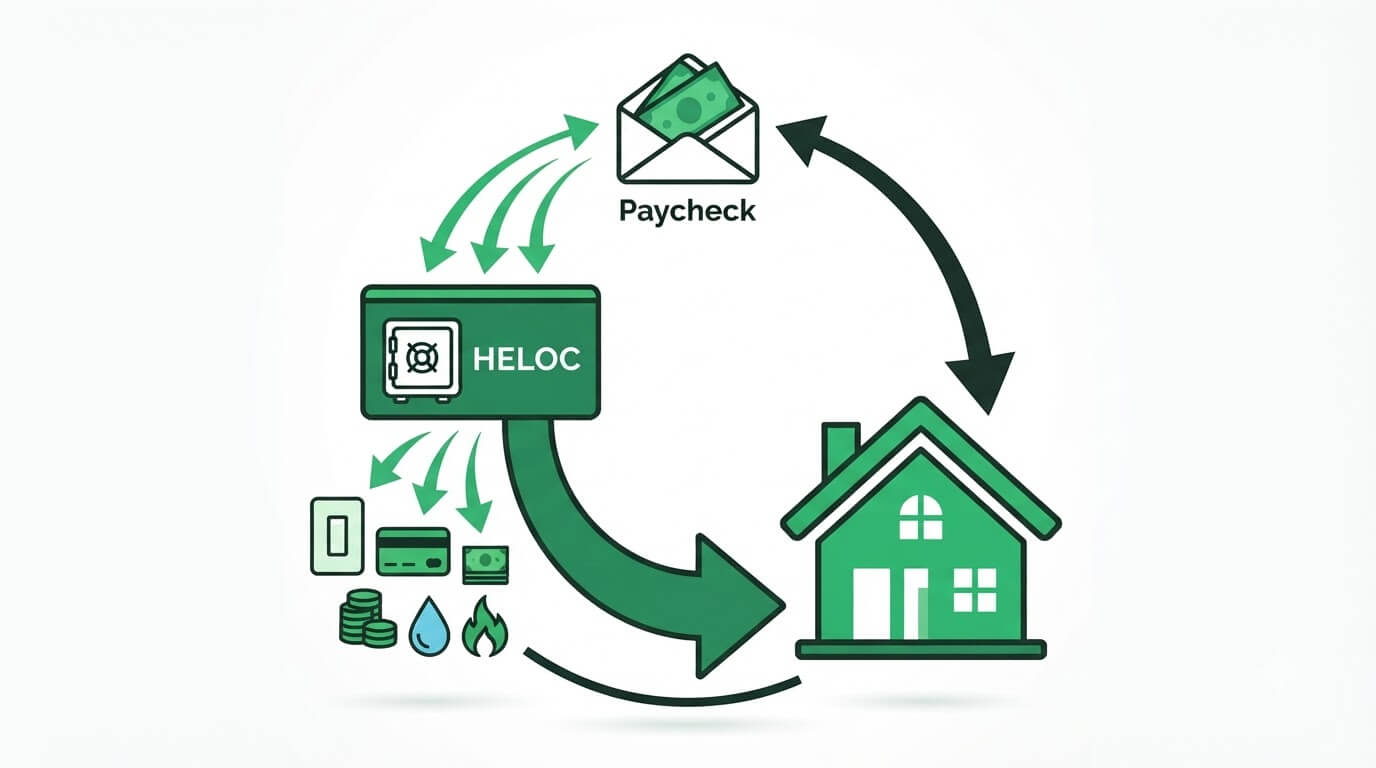
Velocity Banking doesn’t change your loan. It changes the order and timing of how your money moves. The basic cycle looks like this:
- Open a line of credit with available room, most often a HELOC on your home or a personal line of credit.
- Pull a lump sum (people call this a chunk) from the line and send it straight to your mortgage principal.
- Deposit your whole paycheck into the line of credit so the balance drops right away.
- Pay your normal bills from the line as they come due.
- Once your leftover cash flow has paid the line back down, send another chunk and repeat.
The reason this works comes down to how the interest is calculated. HELOC interest is usually figured daily on the average balance, so every dollar of income sitting in the line, even for a few days, lowers the interest that builds up. Meanwhile, each chunk cuts the mortgage principal, and that principal stops generating interest for the rest of the loan.
Does it work? Here’s what the math says
Yes, with one condition that nobody gets to skip: you need positive cash flow. Your income has to be higher than your expenses every month. Velocity Banking speeds up the money you already have left over. It doesn’t create money out of thin air.
Here’s a simple example with round numbers. Say a household brings home $6,000 a month and spends $4,500. That leaves $1,500 in cash flow. They send a $10,000 chunk from the HELOC to the mortgage. The mortgage balance drops by $10,000 that same day. Their $1,500 monthly surplus then pays the HELOC back down in roughly seven months, a little longer once you count the HELOC interest. Then they do it again.
One of my clients, Bryson R., told me he was skeptical at first and ran the concept very conservatively. Since October 2018 he has paid off $16,000. That isn’t a flashy number, and I like that. It’s what steady, disciplined cash flow looks like when it’s pointed in one direction.
| Factor | Traditional Amortization | Velocity Banking |
|---|---|---|
| Where your paycheck goes | Checking account, where it sits until bills are paid | Line of credit, where it lowers the balance right away |
| How extra money hits the mortgage | Small extra payments, if any | Larger chunks sent to principal |
| Who sets the pace | The bank’s 30-year schedule | Your monthly cash flow |
| What you need | A steady payment | Positive cash flow and spending discipline |
| Main risk | Paying far more interest over time | Treating the credit line like spending money |
Where Velocity Banking stops working
I’d rather tell you this now than have you find out the hard way. The strategy breaks down in a few situations:
- Your cash flow is zero or negative. If there’s nothing left over, the HELOC balance never comes back down.
- You treat available credit as spending money. A line of credit is revolving, so if you keep drawing on it for lifestyle purchases, you end up deeper in debt.
- HELOC rates climb and your surplus is thin. Most HELOCs are variable, so a small cash flow cushion can get eaten up by a rate increase.
Velocity Banking is also a debt payoff tool. On its own, it isn’t a wealth building plan. Once the debt is gone, the question becomes where that freed up cash goes next. For many families I work with, that answer is a properly designed whole life policy, which I cover in my post on the Velocity Banking and Infinite Banking combined framework.
How to know if you’re ready
Start with your numbers. You should know your monthly income, your monthly expenses, your total debt, and what’s left over. My free resources page has a simple download that walks you through your four major numbers. Fill that out before you open any line of credit.
Then look honestly at your habits. If you tend to spend whatever is sitting in your account, fix that first. The math only works if the behavior behind it holds up.
Want to know if Velocity Banking fits your numbers?
Bring your income, expenses, and debt balances to a one-on-one call. We’ll map out whether a chunk strategy makes sense for your household and what the first step should be.
Book a Strategy CallFrequently Asked Questions
Do I need a HELOC to do Velocity Banking?
A HELOC is the most common tool, but some people use a personal line of credit instead. What matters is a revolving line you can deposit income into and draw from as bills come due.
How fast can Velocity Banking pay off a mortgage?
It depends entirely on your cash flow, your chunk size, and your interest rates. A household with a large monthly surplus will move much faster than one with a small surplus.
Is Velocity Banking risky?
The biggest risk is behavior. If you spend from the line of credit on things outside your budget, or your income drops, the balance can grow instead of shrink. With steady cash flow and discipline, the risk is manageable.