
I get some version of this question almost every week: “Denzel, is this Infinite Banking thing actually real, or is it a way for someone to sell me a life insurance policy?” Fair question. I asked it myself the first time someone brought it up to me. The honest answer: the Infinite Banking Strategy is real, it’s math you can verify, and it’s also frequently sold badly by people who don’t design the policy correctly. Both things are true at once.
What follows is the version I wish someone had handed me — not a sales pitch, a working explanation of what this strategy is, how it functions, and where people get it wrong.
What the Infinite Banking Concept Actually Is
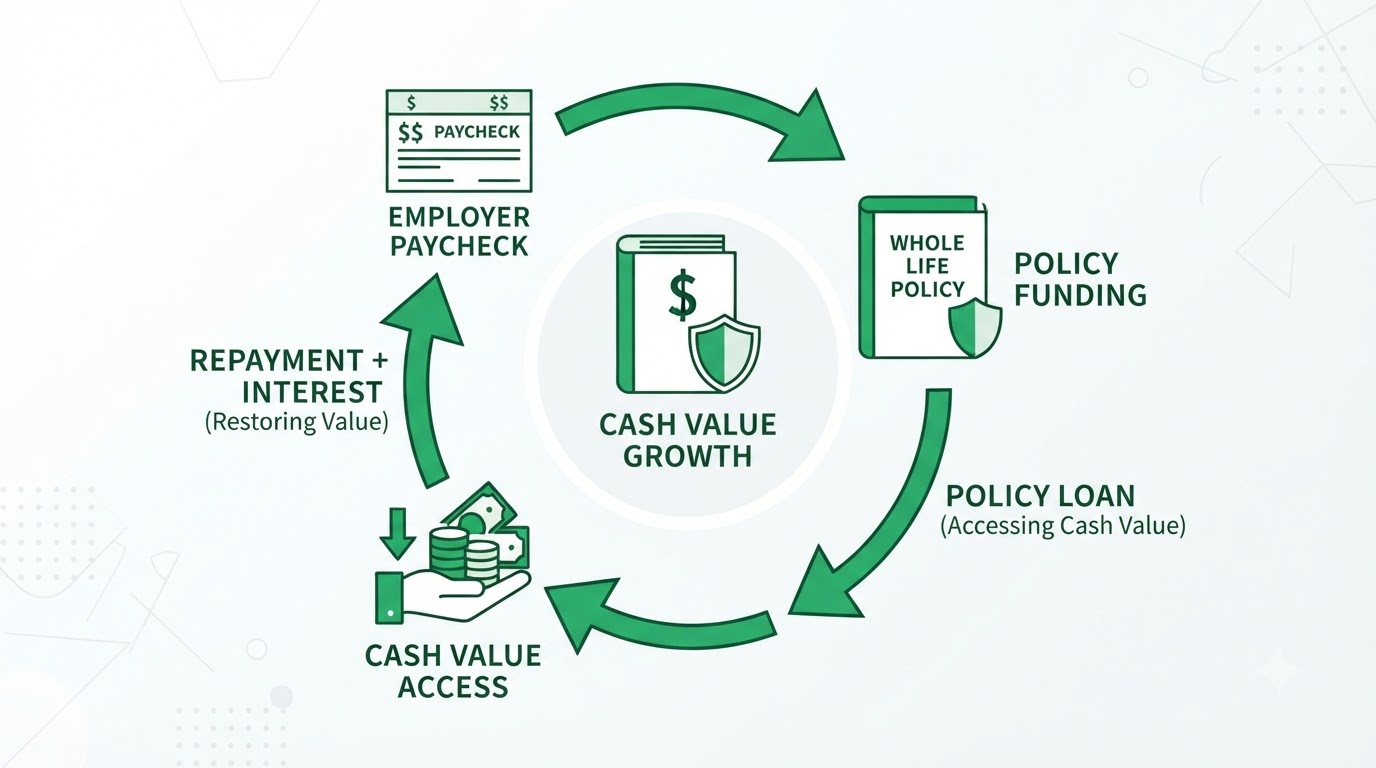
Strip away the marketing language and the Infinite Banking Concept (IBC) comes down to this: you fund a specially designed whole life insurance policy well beyond the minimum premium, that overfunding builds cash value quickly, and once there’s meaningful cash value sitting in the policy, you can borrow against it instead of going to a bank. You repay yourself on your own schedule. Meanwhile, your full cash value keeps earning inside the policy the entire time the loan is outstanding.
That last part is the piece people miss. It’s not “your money leaves the account when you borrow it.” The insurance company is lending against your cash value as collateral — your dollars stay put and keep compounding while you’re using borrowed funds elsewhere.
I explain the full mechanics, company selection, and the two things I tell every client they need for a policy to actually work — on the Infinite Banking overview page, including which mutual companies we typically design around and their current dividend history.
Why a Whole Life Policy Functions Like a Private Bank
A bank takes your deposit, pays you close to nothing on it, then lends that same money back out to someone else at a much higher rate. Infinite Banking flips that structure so you’re the depositor and the lender.
| Traditional Banking | Infinite Banking |
|---|---|
| You deposit cash in a savings account | You fund a whole life policy’s cash value |
| Bank pays you a small, variable interest rate | Policy grows on a guaranteed schedule, plus potential dividends |
| Bank lends your deposit to someone else | You borrow against your own cash value |
| You lose access to funds you deposit | Full cash value keeps earning even while loaned out |
| Interest you pay goes to the bank | Interest you pay goes back into your financial system |
This only works because of one specific feature: mutual insurance companies that pay dividends. On our site, we point people toward major mutual companies — the kind that have been paying dividends for over a century and carry the credit ratings to back it up. It’s also worth knowing that roughly 90% of life insurance policyholders never realize they can borrow against their own cash value at all — most people are sitting on a resource they’ve never touched.
Policy Design: The Part Most Agents Get Backward
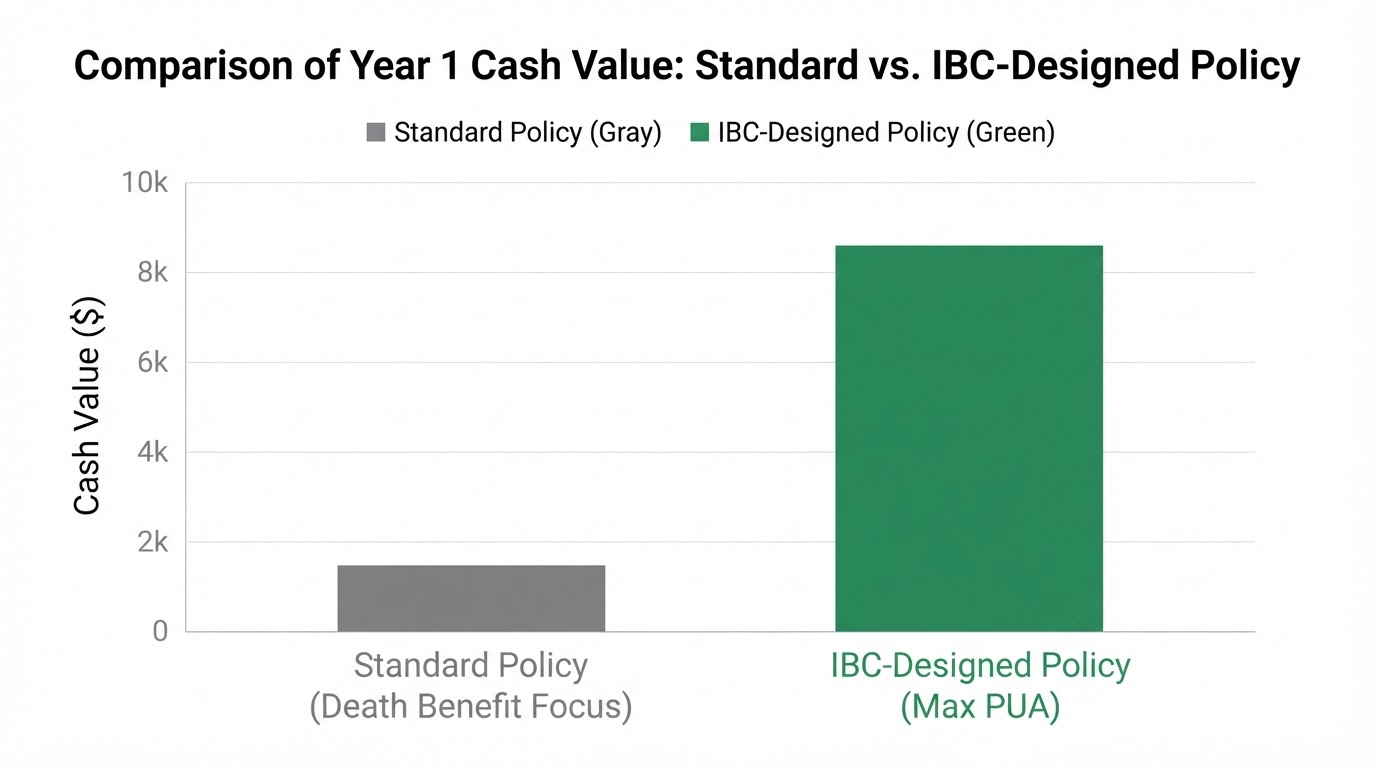
Not every whole life policy is built for Infinite Banking, and this is where a lot of well-meaning people end up disappointed. An “off-the-shelf” policy sold for maximum death benefit will often show close to $0 in cash value in year one. A policy engineered for IBC — minimum base premium, maximum Paid-Up Additions (PUA) rider — behaves completely differently, often reaching 80–90% of cash value in year one, with break-even typically landing between years three and six.
That gap is the single biggest factor in whether IBC works for you. I go deep on the structural differences — and when universal life gets mentioned as an alternative — in Whole Life vs. Universal Life for Infinite Banking. If you’re about to sit down with an agent, read that one first.
How Policy Loans Actually Work
This is usually where people get either excited or skeptical, so I’ll be direct: when you take a policy loan, you’re not withdrawing your own money. The insurer lends you money from its general account, using your cash value as collateral. Your policy keeps earning as if the money never left.
You set your own repayment terms — no bank underwriting, no credit check, no fixed monthly due date. That flexibility is real, and it’s also exactly where I see people get into trouble, usually because they treat the loan like free money instead of a debt still quietly accruing interest.
For the full breakdown — how interest gets calculated, what happens if a loan isn’t repaid, and how this ties back into using leverage strategically — see How Policy Loans Work in the Infinite Banking Strategy.
Where People Go Wrong With IBC
I’ve sat across from enough people to see the pattern repeat. Underfunding the policy in year one. Working with an agent who designed it for death benefit instead of cash value. Borrowing too early, before there’s enough cash value to make it worthwhile. These aren’t edge cases — they’re the norm for policies sold by people who don’t specialize in this strategy.
How Infinite Banking Fits With Your Other Strategies
I don’t teach Infinite Banking as a standalone move. For most families I work with, Velocity Banking comes first — it clears the mortgage and high-interest debt using cash flow you’re already generating. Once that runway is clear, Infinite Banking becomes the next move: a place to redirect that freed-up cash flow so it builds a system you control, instead of disappearing into higher spending. One strategy clears the runway. The other builds what takes off from it.
Realistic Expectations: This Takes Years, Not Months
Properly designed policies typically hit break-even somewhere in years three through six, and the real power of the strategy — the compounding, the recycled interest, the growing capacity to fund your own purchases — shows up over a decade or more, not a single tax year.
If someone’s pitching you Infinite Banking as a fast return, that’s a signal to slow down and ask harder questions, not speed up.
Frequently Asked Questions
Is the Infinite Banking Strategy the same thing as buying life insurance?
No. It uses a whole life policy as the vehicle, but the strategy — overfunding for cash value, borrowing against it, repaying yourself — is what makes it Infinite Banking. A standard whole life policy sold for death benefit alone won’t accomplish the same thing.
How much do I need to start?
There’s no universal number — it depends on your income, goals, and what your policy is designed to do. That’s exactly the kind of thing worth working through in a consultation rather than guessing at from a blog post.
Can I lose money with Infinite Banking?
Poor policy design, early lapses, and mismanaged loan balances can all erode the strategy’s value. Design and discipline matter more than which company you pick.
How is this different from investing in the stock market?
It’s a cash-flow and liquidity strategy with guaranteed growth components, not something meant to compete with equities on return. Whole life’s cash value and tax treatment are well documented; NerdWallet’s overview of whole life insurance is a solid neutral second source.
Ready to Build Your Own Private Banking System?
Everything above is the framework. What it looks like with your actual income, your actual timeline, and your actual goals is a different conversation — one I have with people every week for $350. If you’re ready to see how the Infinite Banking Strategy applies to your own numbers instead of a hypothetical, that’s what this call is for.